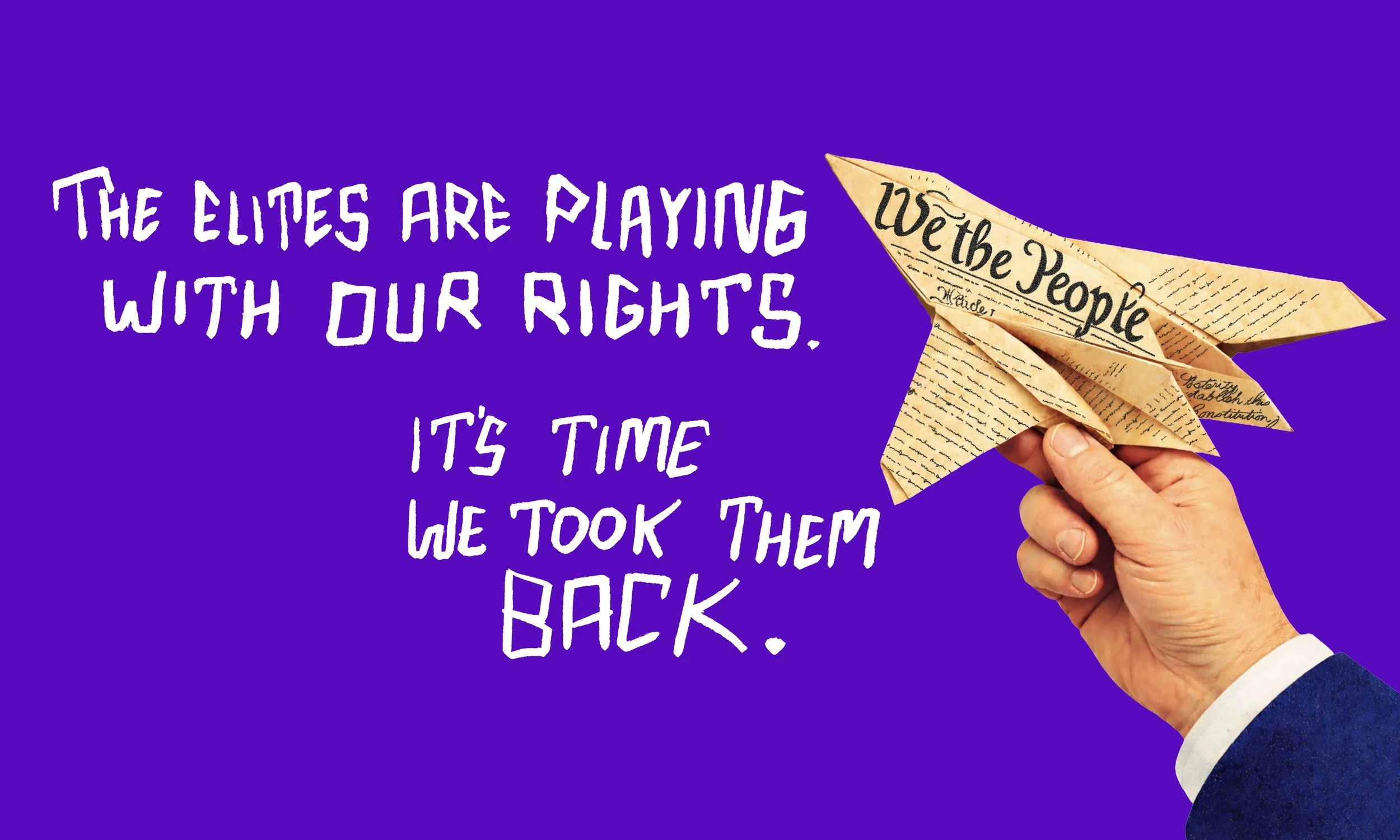
The People’s Bill of Rights 250 exists to ask the American People fundamental questions about freedom, power, and responsibility before anyone else writes the answers.
Institutions are no longer trusted to reflect the will of the people. Elections feel transactional. Courts feel distant. Public debate feels performative rather than constructive.
At the same time, there is no shared civic mechanism for Americans to deliberate together across differences.
We exists to fill that gap. It is designed to invite participation across political, cultural, and generational lines. It is guided by constitutional scholars, experts on both sides of an issue, and everyday Americans—but owned by no party and no campaign.
The 250th anniversary of the Declaration of Independence offers a rare civic moment: not to celebrate consensus, but to rebuild participation. This project does not attempt to replace existing institutions - it restores the missing step before them: public deliberation.
The risk of doing nothing is more of the same. Is that what we want? The mic is being passed. We are the authors now.

-
In 1787, the Founders wrote the Constitution as a starting point, not a final word. It was always intended to be amended.
They included Article V to make sure every generation could change it.
They expected us to refresh it so it works for our time. Jefferson suggested every 19 years.
The Constitution was written for a country of 3 million people, no internet, no modern economy and no political parties and only 13 states. It was written on sheep skin with quills by the light of a candle.
Today we have 330 million people, a digital world, 50 states and 16 U.S. territories, and deep divisions.
The Founders built in the right—and responsibility—to update it.
-
Laws can change with every election—but amendments are forever. They hard-code our rights into the foundation of the country, beyond the reach of partisan power grabs. Real change means rewriting the rules at their source.
-
Through a nationwide digital process that invites millions of Americans to directly shape the future of the country. We are asking participants to discuss, deliberate, share, and weigh in on specific proposals - such as a right to healthcare, equality, digital privacy, or environmental protections - ensuring that the priorities written into the new People’s Bill of Rights 250 truly reflect the will of the people.
-
We take it to the people again - asking the entire country to weigh in on the new amendments that emerged from deliberations. Once a strong majority of Americans - for example, 70% or more - support proposed amendments, the results are presented to Congress and state legislatures under Article V of the U.S. Constitution. This mandate can then trigger one of two pathways to change: either Congress initiates a constitutional amendment process, or a Convention of States is convened, where representatives from every state come together to draft and debate new amendments or sections of a modernized Constitution.
-
Amending the Constitution requires both legitimacy and public trust. Under Article V, amendments can be proposed by a two-thirds vote of Congress or through a convention called by two-thirds of the states, and must then be ratified by three-fourths of the states. While this process was designed to allow change, it has often kept constitutional renewal out of reach of everyday people. The People’s Bill of Rights 250 seeks to bridge that gap by creating a clear, democratic pathway for the public to deliberate, shape, and collectively endorse new constitutional rights - before they ever reach Congress or the states.
-
You can join by signing up for the People’s Vote, adding your voice to national deliberations, and helping shape the People’s Bill of Rights 250. Everyone is invited — because rewriting the future starts with all of us.
We believe that people are the true experts in their own lives - and that it’s long past time they had a real say in the future of America.
People’s Bill of Rights 250 is designed to do exactly that: to hand the microphone back to the people. This project belongs to all of us.
This initiative is powered by Fame Currency, The People, Frankly, and People First, who share a commitment to people-powered democracy and a Constitution that reflects who we are — and who we’re becoming.